
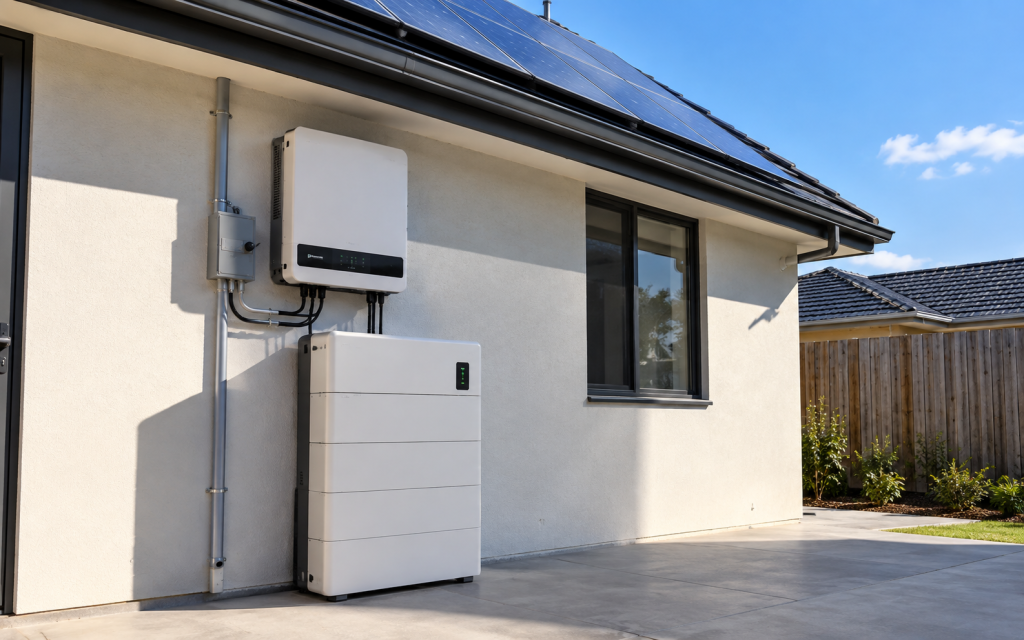
Are you considering installing a solar battery in Melbourne but unsure how much it will cost? With electricity bills placing pressure on household budgets, more Victorian homeowners are looking for practical ways to store solar energy, reduce electricity purchases and gain greater control over their energy use. Understanding solar battery cost Melbourne is an important first step before choosing a battery storage system. Prices depend on battery capacity, brand, inverter compatibility, installation requirements and available government incentives. In 2026, Australia’s Cheaper Home Batteries Program is helping eligible households reduce the upfront cost of solar battery installation. However, choosing the right system requires more than comparing the cheapest advertised prices. This guide from Green Energy Upgrades explains current solar battery prices in Melbourne, federal incentives, installation costs, battery sizes, potential savings and the factors to consider before investing.
Solar Battery Cost Melbourne: How Much Will You Pay in 2026?
The solar battery cost Melbourne homeowners pay varies significantly depending on the system’s storage capacity and installation complexity. According to Australian consumer organisation CHOICE, the following are indicative prices for common home battery sizes in 2026, after the current federal battery incentive and including basic installation.
| Battery capacity | Estimated installed price after federal incentive |
|---|---|
| 10kWh solar battery | $7,000–$11,000 |
| 15kWh solar battery | $11,000–$15,000 |
| 20kWh solar battery | $14,000–$19,000 |
| 30kWh solar battery | $18,000–$22,000 |
Source: CHOICE’s 2026 solar battery buying guide. Prices are indicative Australian market ranges in AUD, not Green Energy Upgrades quotations. Actual Melbourne prices may differ depending on the product and site requirements. These estimates include basic installation, but additional equipment or electrical upgrades may increase the final price. Homeowners comparing solar battery cost Melbourne should request detailed quotations explaining the battery’s usable storage capacity, included inverter, installation labour, backup capabilities and applicable incentives.
Solar Battery Cost Melbourne for 10kWh, 15kWh and 20kWh Systems
Different battery sizes suit different households.
10kWh solar battery A 10kWh battery may be appropriate for households with moderate evening electricity usage and sufficient daytime solar generation. It can help store surplus solar electricity for use after sunset. However, the actual amount of energy available depends on usable capacity, system efficiency and operating settings.
15kWh solar battery A 15kWh battery may suit larger families or homes with higher electricity consumption after dark. Households using reverse-cycle air conditioning, electric cooking or other high-consumption appliances may benefit from considering this storage capacity.
20kWh solar battery A 20kWh system provides greater storage capacity for households with higher electricity demand, electric vehicles or plans for further electrification. However, larger batteries are not automatically more economical. If the household cannot regularly charge and use the available capacity, the additional investment may provide limited financial benefit.
Solar Battery Cost Melbourne: What Should Your Quote Include?
When reviewing solar battery cost Melbourne quotations, check that the installer clearly identifies:
Battery brand, model and usable storage capacity.
Inverter type and compatibility with existing solar panels.
Installation labour and electrical safety requirements.
Switchboard modifications and additional wiring, if required.
Backup power features and any additional equipment.
Manufacturer’s product warranty and workmanship warranty.
Federal battery incentive deductions.
GST and the final amount payable.
A transparent quotation makes it easier to compare solar battery systems based on overall value rather than advertised starting prices alone.
What Factors Affect Solar Battery Installation Cost in Melbourne?
Several factors influence the final price of a residential solar battery installation.
1. Battery Storage Capacity
Storage capacity is measured in kilowatt-hours (kWh). Larger batteries generally cost more upfront, although their cost per usable kWh can be lower because certain installation and hardware expenses are shared across a larger system. Choosing the correct size requires understanding both daily solar production and evening electricity consumption.
2. Battery Brand and Technology
Battery brands differ in their software, monitoring functionality, warranty conditions, output capabilities, efficiency and compatibility. Systems from manufacturers such as GoodWe, Sungrow, BYD and Tesla may offer different specifications and installation requirements. Compare complete system quotations rather than relying on battery brand alone.
3. Existing Solar Inverter Compatibility
If you already have solar panels, your existing inverter may or may not support a battery directly. Some systems require a compatible hybrid inverter, while others can use an AC-coupled battery arrangement with a separate inverter. The installation approach can significantly affect the overall solar battery cost Melbourne homeowners encounter.
4. Electrical Installation Requirements
Installation prices can increase if the property requires:
Switchboard upgrades.
Longer cable runs.
Additional electrical protection.
Complex mounting arrangements.
Special backup circuits.
Network connection adjustments.
An installer should assess the property before confirming the final price.
5. Government Incentives
Eligible federal incentives can reduce the upfront cost of a solar battery system. The incentive amount depends on usable battery capacity, installation date, applicable certificate factors and the value of Small-scale Technology Certificates (STCs).
Solar Battery Rebates Melbourne 2026: How Can You Save?
The Australian Government’s Cheaper Home Batteries Program supports eligible households and businesses installing solar battery systems alongside new or existing rooftop solar. Launched on 1 July 2025, the program generally works through an upfront discount facilitated by installers or registered agents using STCs. The program changed on 1 May 2026, introducing capacity-based incentive tiers.
Federal Solar Battery Incentive Rules in 2026
For installations from May to December 2026, the base STC factor is 6.8 certificates per eligible usable kWh, subject to capacity-based reductions.
The current tiers are:
| Usable battery capacity | Applicable STC factor |
|---|---|
| First 14kWh | 100% of base factor |
| Above 14kWh to 28kWh | 60% of base factor |
| Above 28kWh to 50kWh | 15% of base factor |
This means the incentive does not increase at the same rate across all battery sizes. Illustrative example: A qualifying battery with exactly 10kWh of usable capacity would generate 68 STCs under the May–December 2026 base factor. If each STC were valued at $38, the indicative discount would be $2,584. This is an example, not a guaranteed rebate. Certificate values and eligible battery capacity can affect the actual amount. The base STC factor is scheduled to reduce again on 1 January 2027, so installation timing may also affect the available incentive. For accurate calculations, use the Clean Energy Regulator’s official solar battery guidance.
Who Is Eligible for the Federal Battery Incentive?
Under the current program rules, qualifying installations generally must meet requirements including:
A new battery system with a nominal capacity of 5kWh to 100kWh.
Installation alongside a new or existing eligible solar PV system.
Equipment appearing on the applicable Clean Energy Council approved list.
Installation by an appropriately accredited installer with battery endorsement.
Compliance with applicable Australian electrical safety standards.
Technical capability to participate in a Virtual Power Plant where required.
The program only supports STCs on the first 50kWh of usable battery capacity, and generally permits one eligible battery system per premises. A battery must be technically capable of VPP participation where required, but homeowners are not necessarily required to join a VPP.
Is There a Separate Victorian Solar Battery Rebate in 2026?
The Victorian Government previously supported battery installations through its Solar Homes battery rebate and interest-free loan initiatives. However, Solar Victoria is no longer accepting applications for its battery loan program. Victorian households should therefore assess eligibility for the federal Cheaper Home Batteries Program rather than assuming that an additional Victorian battery loan or rebate is available. Official program information is available through Solar Victoria.
GoodWe Solar Battery Prices Melbourne: Is a 24kWh System Worth Considering?
For households exploring larger storage systems, GoodWe offers integrated solar battery solutions that combine battery storage with compatible inverter technology. The GoodWe ESA series includes modular storage configurations that can support a range of household requirements. A 24kWh GoodWe ESA configuration may interest homeowners who:
Have substantial daytime solar generation.
Use significant electricity during the evening.
Plan to install an electric vehicle charger.
Want to increase household electrification.
Are interested in a suitable backup power configuration.
However, the price of a GoodWe 24kWh battery system depends on the precise model, inverter configuration, installation requirements and applicable incentives. Homeowners should confirm whether quoted capacity represents nominal or usable storage before comparing products.
Benefits of Considering a GoodWe Battery
Depending on the selected model and system design, possible advantages include:
Integrated technology: Compatible battery and inverter components can simplify the design of a complete solar storage solution.
Modular storage: Certain GoodWe ESA configurations support expandable battery arrangements.
Energy monitoring: Compatible monitoring software can help homeowners understand solar generation, battery charging and household electricity usage.
Backup options: Supported configurations can provide emergency electricity during power outages when installed with the required backup functionality. The correct choice should be based on a qualified assessment rather than battery capacity alone. For homeowners comparing solar battery cost Melbourne, a tailored GoodWe quotation can help clarify whether a larger battery delivers enough practical value to justify the investment.
Can You Add a Solar Battery to an Existing Solar System?
Yes. In many cases, Melbourne homeowners can add battery storage to an existing rooftop solar system. Before installation, the existing equipment should be assessed for compatibility.
AC-Coupled vs DC-Coupled Solar Batteries
AC-coupled battery systems operate through a battery inverter connected to the household electrical system. They can be useful when retrofitting storage to an existing solar installation.
DC-coupled systems generally use a compatible hybrid inverter to manage solar generation and battery storage. Neither option is automatically best for every property. The decision depends on the existing inverter, system age, available space, electrical configuration and intended backup capabilities. Adding a battery can also require network approval or other electrical work. For this reason, an onsite or sufficiently detailed technical assessment is important before accepting a battery installation quote.
Is a Solar Battery Worth It in Melbourne in 2026?
A solar battery can provide financial and practical advantages, but it is not automatically the best investment for every home. The financial result depends on how much stored electricity you actually use and how much grid electricity you avoid purchasing.
How Solar Batteries Help Reduce Electricity Bills
Without a battery, excess rooftop solar electricity is often exported to the electricity grid. With a suitable battery, some of that electricity can instead be stored and used during the evening or at other times when the panels are not producing enough power. This can reduce the amount of electricity purchased from an energy retailer.
The financial benefit depends on:
The price paid for grid electricity.
The feed-in tariff received for exported solar energy.
The battery’s round-trip efficiency.
The amount of stored electricity used each year.
The battery’s purchase and installation cost.
Example: Estimating Solar Battery Savings
Consider an illustrative Melbourne household with these assumptions:
| Factor | Example |
|---|---|
| Electricity displaced by battery | 8kWh per day |
| Grid electricity price | $0.35/kWh |
| Solar feed-in tariff | $0.05/kWh |
| Battery round-trip efficiency | 90% |
| Days of full utilisation | 300 annually |
Under these assumptions, the household avoids approximately $2.80 in grid purchases per fully utilised day. Allowing for the value of solar energy that could otherwise have been exported and the assumed efficiency loss, the estimated net benefit is approximately $707 per year. This example excludes financing, maintenance, battery degradation, tariff changes and other possible costs or benefits. It is not a promised saving. Some households may achieve higher savings, while others may achieve less.
How Long Does a Solar Battery Take to Pay for Itself?
A simplified payback calculation divides the upfront battery cost by estimated annual financial savings.
For example: $9,000 net installation cost ÷ $900 annual savings = 10 years. This is a simple illustrative payback period, not a forecast for a particular Melbourne household. A proper calculation should also account for changes in electricity prices, battery performance, export tariffs, operating costs and expected system life.When researching solar battery cost Melbourne, it is important to compare long-term financial performance alongside the initial purchase price.
How to Choose the Best Solar Battery Size for Your Melbourne Home
Buying a larger solar battery does not automatically mean receiving greater financial value. The most suitable size depends on a combination of solar generation, electricity usage and future household plans.
Small to Medium Households
Homes with lower evening consumption may find that a smaller battery is sufficient to capture and use available excess solar electricity. An oversized battery could remain partially unused, particularly during Melbourne’s shorter winter days.
Larger Family Homes
Larger households may benefit from greater storage when evening electricity consumption is consistently high. Air conditioning, heating, cooking and other appliances can contribute to demand after sunset.
Homes with Electric Vehicles
Electric vehicle ownership may increase household electricity consumption significantly. However, the optimal battery size depends on charging habits, vehicle usage and whether the vehicle can be charged directly from rooftop solar during daylight hours.
Homes Requiring Blackout Protection
Not every solar battery automatically supplies electricity during an outage. If backup power is important, confirm the supported inverter functions, backup circuits, transfer arrangements and maximum output. Solar Victoria advises that backup must be incorporated into the system design.
How to Reduce Solar Battery Cost Melbourne Without Compromising Quality
There are several practical ways to improve the value of your installation.
Choose the appropriate capacity. Base battery size on actual energy consumption rather than purchasing the largest available system.
Check federal incentive eligibility. Confirm approved equipment, installation requirements and the discount applied to your quote.
Compare complete quotations. Assess inverter costs, electrical work, warranties and backup functionality rather than just the advertised battery price.
Consider existing solar compatibility. A suitable retrofit configuration may avoid unnecessary equipment replacement.
Review warranty and installer credentials. Look beyond initial price and consider long-term reliability, support and compliance.
Understand household energy usage. Reviewing electricity bills and solar monitoring data can help identify whether battery storage is likely to provide worthwhile benefits.
A well-designed system should provide the right combination of capacity, functionality, reliability and financial value.
Why Consider Green Energy Upgrades for Solar Battery Installation in Victoria?
Green Energy Upgrades helps Victorian customers explore more energy-efficient solutions for their homes and businesses. If you are researching solar battery cost Melbourne, understanding the available product options, installation requirements and government incentives can help you make a more informed purchasing decision. Whether you already have rooftop solar or are considering a new solar and battery package, the right system should be selected around your electricity usage, existing equipment and long-term energy goals. A personalised quotation can help you compare suitable battery capacities, inverter configurations and available incentives.
Ready to explore solar battery storage for your home? Contact Green Energy Upgrades to discuss suitable solar battery options and request a quotation for your Victorian property.
Frequently Asked Questions About Solar Battery Cost Melbourne
1. How much does a 10kWh solar battery cost in Melbourne in 2026?
CHOICE reports an indicative installed price of approximately $7,000 to $11,000 for a 10kWh home battery after the current federal incentive, including basic installation. Actual prices depend on equipment, installation requirements and additional electrical work.
2. What is the average solar battery cost Melbourne homeowners should budget for?
There is no single fixed price. Homeowners should consider their required storage capacity, existing inverter and installation requirements. Indicative 2026 prices range from approximately $7,000 for some 10kWh systems to more than $20,000 for certain larger configurations.
3. Is the solar battery rebate available in Victoria in 2026?
Yes. Eligible Victorian households can access the federal Cheaper Home Batteries Program. The discount is generally applied through the STC process. Solar Victoria’s former battery loan program is closed to new applications.
4. Can I install a battery if I already have solar panels?
Yes. Many existing solar installations can be upgraded with a compatible battery. Depending on the inverter, you may need additional equipment or a different installation configuration.
5. How much does a 24kWh GoodWe battery cost?
The final cost depends on the exact GoodWe model, inverter, installation work and available federal incentives. A personalised quotation is necessary to establish an accurate installed price.
6. Does a solar battery work during a blackout?
Only if the system is designed and installed to provide backup power. Some grid-connected battery systems shut down during power outages. Check the supported backup capability before purchase.
7. Are solar batteries worth installing in Melbourne?
They can be worthwhile for households with sufficient surplus solar generation and significant electricity use outside daylight hours. Financial outcomes vary, so an individual savings and payback assessment is recommended.
8. Will solar battery rebates change in 2027?
Under the current federal schedule, the base STC factor is set to decrease from 6.8 to 5.7 on 1 January 2027. The actual incentive value will also depend on eligible battery capacity and STC market value.
Final Thoughts: Is Solar Battery Storage a Smart Investment?
Understanding solar battery cost Melbourne in 2026 involves more than checking the initial price of a battery. The right investment depends on storage capacity, household energy usage, inverter compatibility, installation quality, government incentives and expected savings over time. For eligible Victorian homeowners, the federal battery incentive can reduce the initial investment, while a properly sized system may help increase solar self-consumption and reduce reliance on purchased grid electricity. If you want to explore solar battery installation options, including GoodWe battery solutions, Green Energy Upgrades can be a starting point for discussing your needs and requesting a tailored quotation. Get started today: Visit Green Energy Upgrades to enquire about solar battery options for your Melbourne or Victorian property.